
Strata cleaning
Strata Cleaning Sydney
Common property cleaned to a scope that names every area — including the fire stairs, the chute base and the far corner of the car park — and reported to the committee in writing every month, whether the news is good or not.
- Every common area named, not gathered under 'common areas'
- The bin room treated as the hardest room, not the last one
- Written monthly audit sent to the committee or the manager
- Rolling agreement — no lock-in term to explain at a general meeting
Ask us for the paperwork
Every claim on this card has a document behind it, and it reaches you before the first shift rather than after you chase it.
- $20m public liabilityCertificate of currency on request
- Police-checked cleanersWWCC-cleared for schools and childcare
- No lock-in agreementFixed written quote within 24 hours
What does strata cleaning in Sydney cover?
Strata cleaning is the scheduled cleaning of a scheme’s common property — the areas owned collectively rather than by an individual lot owner. In a Sydney apartment building that typically means the entry and lobby, lift cars and lift lobbies on each level, common corridors, fire stairs, bin and recycling rooms, the basement car park and its ramp, letterbox bays, common laundries and any shared rooftop or garden.
The interior of an individual lot is the owner’s responsibility, not the scheme’s, and is not part of a strata cleaning scope. Work is normally reported to the owners corporation committee or to the strata managing agent, who administers the scheme on the owners corporation’s behalf.
Clean Best cleans strata common property across Sydney and has traded since 2015. It names every common area separately in the written scope, walks the building monthly against that scope and sends the result to the committee or manager in writing, carries $20m public liability cover, and works with no lock-in term. Strata quotes are arranged on 02 5839 3012 / 0485 000 860.
- Trading since 2015Cleaning Sydney business premises
- Police-checked cleanersWWCC where the premises requires one
- $20m public liabilityCertificate of currency on request
- Written quote in 24 hoursFixed price, no lock-in agreement
The detail
Strata cleaning Sydney committees can put in front of a general meeting
Strata cleaning Sydneyschemes buy is unusual in one important way: the person paying is a committee, and a committee is a group of volunteers making decisions between meetings with almost no information. If the contractor reports nothing, the committee’s only source of truth is whichever owner complained most recently and most loudly. That is how a building with a perfectly adequate clean ends up changing contractor, and how a genuinely poor one survives for years.
Name every area, because ‘common areas’ is not a scope
The entry and the lobby. Lift cars, and the lift lobby on every single level, which is where a cheap scope quietly stops at level three. Common corridors. Fire stairs. Bin and recycling rooms. The chute base, if there is a chute. The basement car park, its ramp, the visitor bays and the path residents actually walk from the lift to their car. Letterbox bay. Common laundry. Rooftop, garden, pool surround where those exist.
Every one of those gets a line and a cycle. It is more work to write and more difficult to hide behind, which is exactly why it is worth doing. A scope that says “common areas, three times weekly” cannot be failed, cannot be audited, and cannot be tabled at a meeting as evidence of anything.
The bin room is the hardest room in the building
It is enclosed, it is warm, it is wet, and it is the only room in the building that every single resident uses badly. It is also, in our experience, the origin of roughly half the cleaning complaints a Sydney committee receives — and it is the room most scopes mention in four words.
Done properly it needs the bins moved out and returned on collection day, the floor washed rather than swept, the drain treated on a cycle, the walls wiped down, the chute base cleaned where there is one, and the overflow dealt with rather than stepped around. Get the bin room right and a surprising share of the building’s complaints simply stop arriving.
Fire stairs, and the areas nobody looks at
Fire stairs are an egress route. They collect dust, cobwebs and the occasional dumped item, they are inspected by people who are not residents, and nobody ever walks them for pleasure. Which is precisely why they are the first thing cut from a scope written to hit a price. The omission is invisible for a long time and then it is not.
The same applies to the far corner of the car park behind the ramp, the top of the lift architrave, the underside of the letterbox bay. None of it is urgent. All of it is what separates a building that feels maintained from one that merely gets cleaned.
Consumables and equipment, named before the invoice arrives
In strata this is where money disappears quietly. Bin liners, common-area consumables, sometimes light globes, and the question of whether the contractor brings their own equipment or uses the building’s cupboard. If the scope does not put a name against each of those, the cost lands somewhere unexpected and the invoice arrives at the meeting with an explanation that nobody present can check.
Reporting is the product, as much as the cleaning
A supervisor walks the building monthly against the written scope and sends the committee or the strata manager the result — the same walk we did when we quoted, against the same document. If something has slipped, it says so. An audit that always passes is not an audit, it is a newsletter.
That report is what lets a committee do its job: table something factual, answer the owner who complains, and see a trend rather than an anecdote. And because the agreement rolls on 30 days notice, the committee is never in the position of explaining to a general meeting why the building is locked into a contractor it no longer wants.
Call 02 5839 3012 / 0485 000 860 and we will walk the common property with the committee or the strata manager and write the scope from the building.
Reporting
A committee can only act on what it is actually told
A strata committee is a handful of owners making decisions between meetings on very little information. When the cleaning contractor reports nothing, the committee's only evidence is whichever resident emailed most recently — which is how an adequate clean gets terminated and a poor one survives for years.
So the monthly audit is not a courtesy, it is the product. A supervisor walks the building against the same written scope we quoted from and sends the result to the committee or the strata manager, in writing, whether it flatters us or not. It is something that can be tabled, filed and compared against last month.
- Monthly written audit against the scope, sent every month
- Findings recorded whether or not they reflect well on us
- A named supervisor with a mobile number, not a ticket queue
- Anything missed is put right before the next visit, at no cost

What's included
What we clean on Sydney strata common property
Every area named. Yours is written from a walkthrough of the actual building with the committee or the strata manager present.
- Entry, lobby and reception area — floors, glazing, entry mats, seating and directory board
- Lift cars: floors, walls, mirrors, control panels and door tracks, with tracks on their own cycle
- Lift lobbies on every level, not only the ground floor
- Common corridors — floors, skirtings, handrails, light fittings on rotation
- Fire stairs on a stated cycle, including landings, handrails and cobweb removal
- Bin and recycling rooms: bins moved and returned, floor washed, drain treated, walls wiped
- Chute base cleaned where the building has a chute
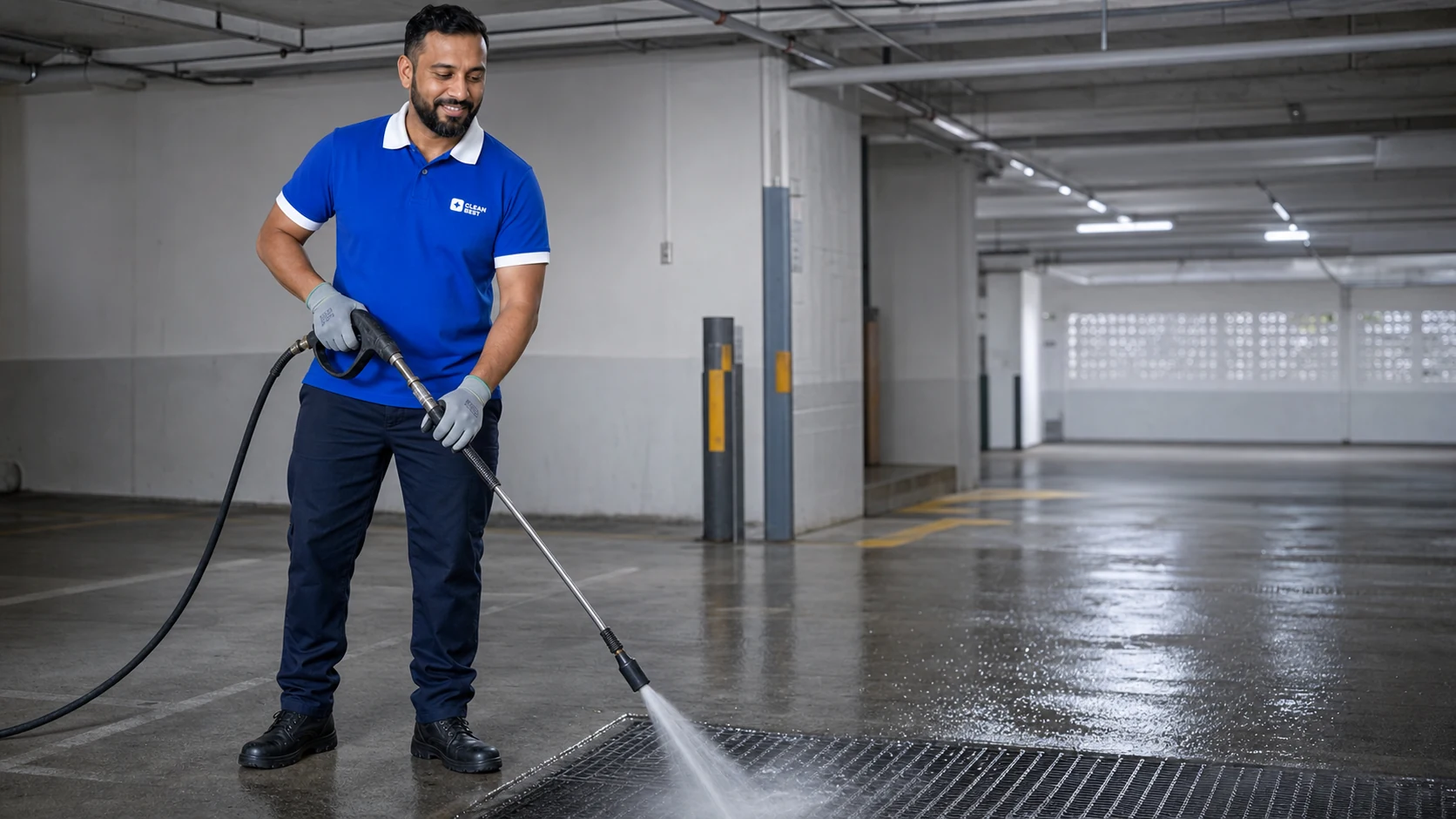
- Basement car park swept or machine-swept, with the ramp and pedestrian path prioritised
- Letterbox bay, intercom panels and the surfaces residents touch daily
- Common laundry — machines wiped externally, floor washed, lint traps flagged
- Shared rooftop, garden or pool surround where they form part of the common property
- Common-area glazing and internal glass kept clear of marks and prints
- Touchpoints disinfected — door furniture, handrails, lift buttons, intercoms
- Periodic programs costed with a cycle: common carpet extraction, pressure washing, high glazing
Excluded: anything inside a lot, work above safe reach, licensed trade work, and hard rubbish removal beyond the building's normal waste arrangement. These are quoted separately where the scheme wants them.
Pricing
Strata cleaning quotes, built area by area from the building
Priced from the number of levels, the lift and lobby count, the bin arrangement, the car park and the reporting the committee wants. Fixed in writing before the first visit.
Small scheme
A boutique block: one entry, a modest lobby, a handful of levels, a bin room and a small car park.
- Lobby, corridors, lift car and fire stairs on a stated cycle
- Bin room washed rather than swept, and the drain treated
- Bins moved and returned on collection day
- One cleaner who becomes a face the residents recognise
Fixed price, in writing, before the first visit.
Mid-rise residential
Multiple levels, lift lobbies on each, a basement car park, a common laundry, and a committee that reads the invoice.
- Every common area named separately in the scope, not lumped together
- Written monthly audit sent to the committee or the strata manager
- Car park and ramp on a machine-sweep cycle
- Periodic work — carpet, glazing, pressure washing — costed with a cycle
Fixed price, in writing, before the first visit.
Portfolio
A strata manager or owner with several Sydney schemes under one arrangement rather than one contractor per building.
- A separate written scope per scheme, one supervisor across all of them
- Consistent reporting format the whole portfolio can be compared on
- Periodic programs sequenced building by building
- One consolidated invoice per period
Fixed price, in writing, before the first visit.
Free walkthrough, then a written scope and a fixed price within 24 hours.
How it works
How a strata clean starts
Four steps, written so the committee has something it can table at the next meeting.
- 1
Tell us about the scheme
Call 02 5839 3012 with the levels, the lift count, the bin arrangement, the car park and who we report to — the committee or the manager.
- 2
We walk the common property
Every area named, including the ones nobody looks at: the fire stairs, the chute base, the corner of the car park behind the ramp.
- 3
A scope the committee can table
Area by area with a stated cycle against each, plus the reporting format. Then the fixed price. Written so it can be tabled at a meeting.
- 4
Start, and report monthly
Your cleaner starts on the agreed date and a supervisor walks the building monthly against the scope, sending the result in writing.
FAQ
Strata cleaning questions from Sydney committees and managers
Common property, bin rooms, reporting, consumables, car parks and fire stairs.
What counts as common property for a strata clean?
Clean Best scopes strata cleaning to the common property, and the scope has to name it rather than gesture at it: the entry and lobby, lift cars and lift lobbies on every level, common corridors, fire stairs, bin and recycling rooms, the basement car park and its ramps, letterbox bays, common laundries and any shared rooftop or garden area. What is inside a lot is the owner's, not the scheme's. A scope that just says 'common areas' will be argued about at the first general meeting.
Why do bin rooms cause so many strata complaints?
Clean Best treats the bin room as the hardest room in a strata building rather than the last one on the list. It is enclosed, warm, wet, and the only room in the building that every resident uses badly. It needs the bins moved and returned on collection day, the floor washed rather than swept, the drain treated, the walls wiped, and the chute base cleaned where there is one. Half the complaints a committee receives about cleaning start in a room the scope barely mentioned.
How is a strata cleaning result reported to the committee?
Clean Best walks the building monthly against the written scope and sends the result to the committee or the strata manager in writing, whether it is flattering or not. A committee is a group of owners making decisions between meetings on limited information, so a cleaning contractor that reports nothing forces them to rely on whichever resident complained most recently. A written monthly audit against a specific scope replaces that with something the committee can actually table.
Who supplies the consumables and equipment in a strata building?
Clean Best states it in the scope, because in strata this is where money quietly disappears. Bin liners, common-area consumables, light globes in some schemes, and the question of whether the building's own equipment cupboard is being used or the contractor brings their own. If the scope does not name the party responsible, the cost lands on whoever notices first, and the invoice arrives with an explanation nobody at the meeting can check.
Can you clean the basement car park?
Clean Best scopes the basement car park with a stated cycle, and it is one of the few areas where a low frequency is genuinely fine — but it must be written. Car parks accumulate tyre rubber, oil drips, leaf litter blown down the ramp and general dust. They are usually swept or machine-swept on a cycle, with the ramp, the visitor bays and the pedestrian path from the lift given more attention because that is the route residents actually walk.
What about fire stairs, which nobody ever looks at?
Clean Best puts fire stairs in the scope with a real cycle, precisely because nobody looks at them. They are an egress route, they collect dust, cobwebs and the occasional dumped item, and they are inspected by people who are not residents. A strata scope that omits the fire stairs is a scope that has been written to be cheap, and the omission stays invisible until the day it is not.
Keep exploring
What strata schemes usually add
Each runs on the same scope, the same supervisor and the same monthly report.
Get strata cleaning Sydney committees can audit rather than argue about
Free walkthrough of the common property, a scope naming every area, and a written monthly report. Call 02 5839 3012 / 0485 000 860.