
Commercial cleaning services
Commercial Cleaning Services Sydney
What the service actually consists of, area by area: the tasks, the cycles they run on, the methods that matter and the things we will not do. Written down before you see a price, so you can tell what the money buys.
- Four scheduling layers, each written into the scope
- Methods named wherever they change the outcome
- Consumables assigned to somebody by name
- Exclusions stated plainly, not discovered later
Ask us for the paperwork
Every claim on this card has a document behind it, and it reaches you before the first shift rather than after you chase it.
- $20m public liabilityCertificate of currency on request
- Police-checked cleanersWWCC-cleared for schools and childcare
- No lock-in agreementFixed written quote within 24 hours
What do commercial cleaning services in Sydney cover?
Commercial cleaning services cover the scheduled cleaning of premises used for business — offices, retail, industrial, strata common areas, clinics, childcare centres, schools and places of worship — as distinct from private homes. In Sydney the work is usually performed outside trading hours so that staff, tenants and customers are not disrupted.
A commercial schedule is normally built in four layers: a core round performed every visit (waste, amenities, kitchens, touchpoints, floors), a weekly detail round, a monthly-to-quarterly rotation covering high-level and concealed areas, and periodic programs such as carpet extraction and hard-floor treatment on their own cycle. Tasks not written into one of those layers are not performed.
Clean Best provides commercial cleaning services across Sydney and has traded since 2015. It issues the written scope of works before the price, carries $20m public liability cover, uses police-checked cleaners, and works on a rolling agreement with 30 days notice. Quotes are arranged on 02 5839 3012 / 0485 000 860.
- Trading since 2015Cleaning Sydney business premises
- Police-checked cleanersWWCC where the premises requires one
- $20m public liabilityCertificate of currency on request
- Written quote in 24 hoursFixed price, no lock-in agreement
Area by area
What commercial cleaning services should specify, room by room
Commercial cleaning services Sydneybusinesses sign up for are almost always described at the wrong altitude. The quote says “general cleaning of all areas, three times weekly”, everybody nods, and the disagreements start in month four. This page is the other altitude: what a commercial schedule contains once you write it down properly, area by area, and why each line is there.
Washrooms are the room the contract is won or lost in
Nobody has ever changed cleaning contractor over a dusty vent. They change over a washroom. So a washroom line in a scope has to say more than “clean and restock”. It should name the fixtures — pans, urinals, basins, tapware, mirrors, partitions, dispensers — state that disinfectant is left for its stated contact time rather than sprayed and immediately wiped away, and say who owns the consumables and who is watching the stock level. The dispenser that is empty on Friday afternoon is a consumables failure, not a cleaning failure, and the two are fixed by different people.
Floor drains and the grout around them belong in the scope too, on a stated cycle. Left out, they are the reason a washroom that is technically clean still smells, and no amount of extra visits fixes a problem nobody has been asked to look at.
Kitchens: the room everybody uses and nobody owns
Benchtops, sinks, tapware, splashbacks, cupboard fronts, microwave interiors, fridge exteriors, and the bin — every visit. The full fridge clear-out belongs on a stated cycle you choose, because it is a social problem as much as a cleaning one and it needs a date everybody has agreed to. Dishwashers, if we are to unload them, must be written in; if they are not, they will not be, and a cleaner who unloads one unasked has quietly taken on a job that will be assumed forever after.
Floors, and the chemistry nobody asks about
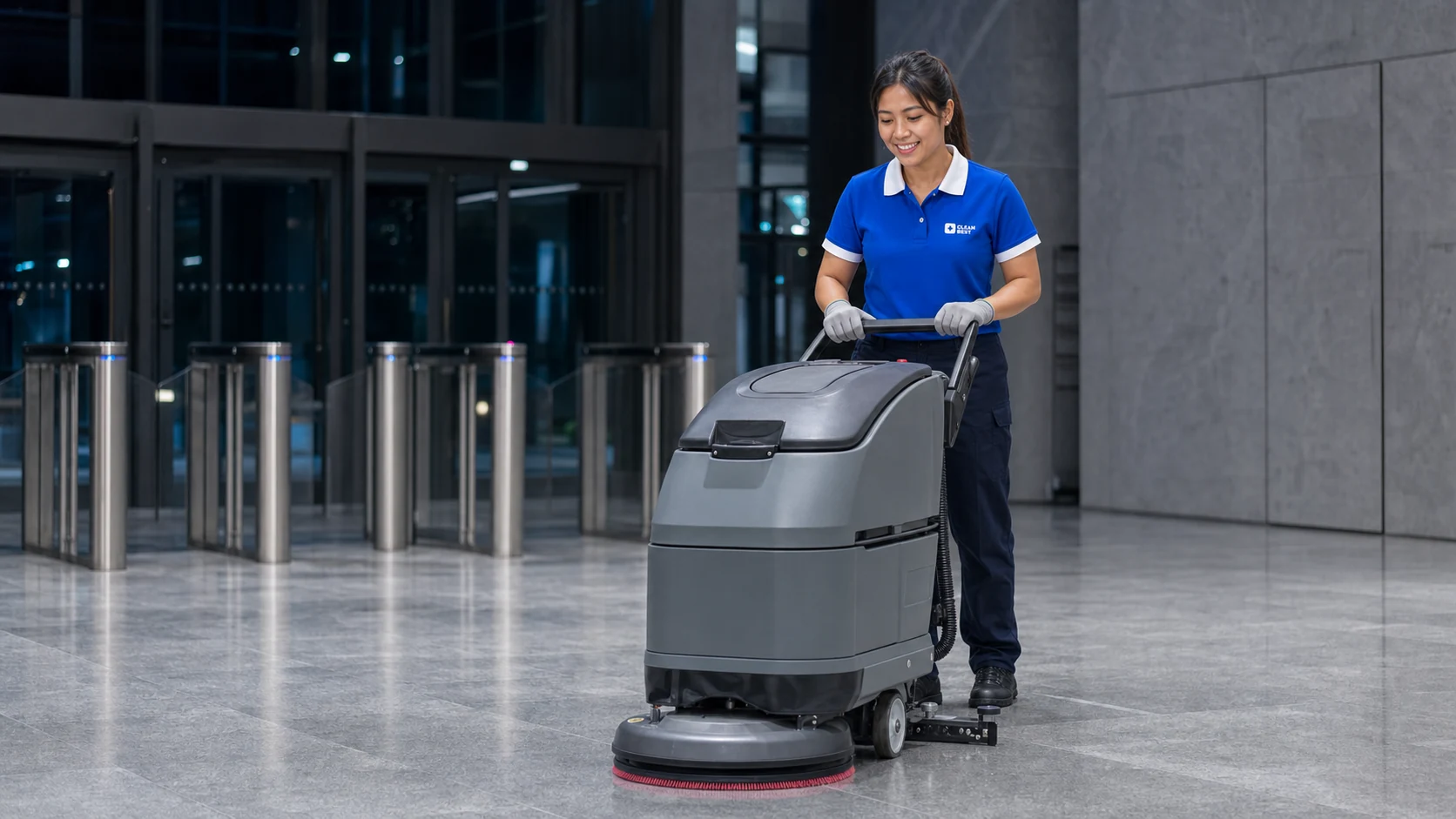
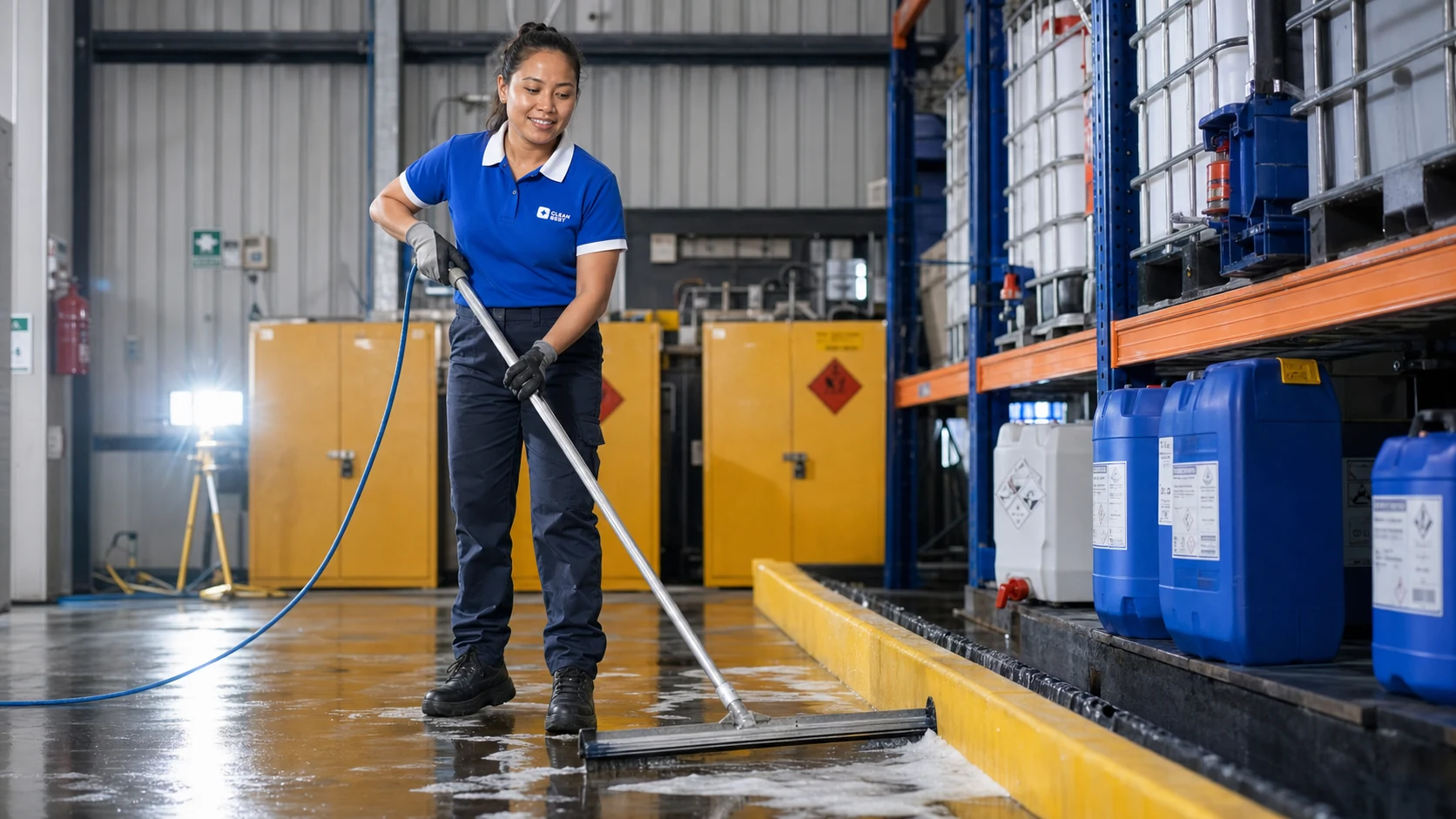
The single most common avoidable damage we see on Sydney commercial floors comes from using the wrong product on the right floor. Sealed timber wants a neutral pH; a strong alkaline cleaner will lift and dull the finish over time. Vinyl responds well to machine work but hates being flooded. Tile is usually fine and its grout usually is not. Sealed concrete in a warehouse is forgiving until somebody strips the seal off it with the wrong degreaser and the slab starts absorbing everything that lands on it.
So the scope should name the surface and the method wherever it changes the outcome, and it should say which floors are vacuumed, which are mopped, which are machine-scrubbed, and on what cycle each is treated. Vacuuming “the carpet” means the traffic lanes unless the scope says under and behind the furniture, in which case it means that.
Touchpoints, and the number nobody observes
Disinfection is a time-based process. Most commercial disinfectants have a stated contact time — the period the surface has to remain visibly wet for the claim on the label to hold. Spray it on, wipe it straight off, and you have cleaned the surface without disinfecting it. Both actions look identical from three metres away, which is exactly why the scope should say the contact time is observed, and why the induction should teach it.
High-level and concealed work, on a real rotation
Vents, light fittings, ceiling corners, partition tops, cable trays, the space behind fixed furniture. None of it is urgent, all of it is visible in aggregate after eighteen months, and it is the first thing dropped when a contract has been priced below the hours it needs. Put it on a monthly or quarterly rotation, name the areas, and it gets done. Leave it to the contractor’s discretion and it is a slow, invisible refund back to them.
Periodic programs are not an upsell
Carpet hot-water extraction, hard-floor stripping and sealing, machine buffing, external and high-reach glass. Equipment-heavy, infrequent, and impossible to hide inside a nightly figure honestly. They belong in the scope with a cycle against each and a clear statement of whether they sit inside the price or are quoted separately. Either answer is fine. Silence is not: a contract that mentions periodic work only as “available on request” is a contract in which it never happens, and the building quietly ages.
And what we will not do
Our cleaners do not move heavy furniture, handle personal belongings, open drawers, sort paperwork, deal with biological spills, or work above safe reach. That list is in the scope, in the terms, and said out loud at the walkthrough. A plainly written exclusion list protects you at least as much as it protects us — it is the difference between a boundary and a surprise.
Call 02 5839 3012 / 0485 000 860 and we will walk the premises after hours and write this for your site rather than describing it in the abstract.
The schedule
Four layers, and everything sits in one of them
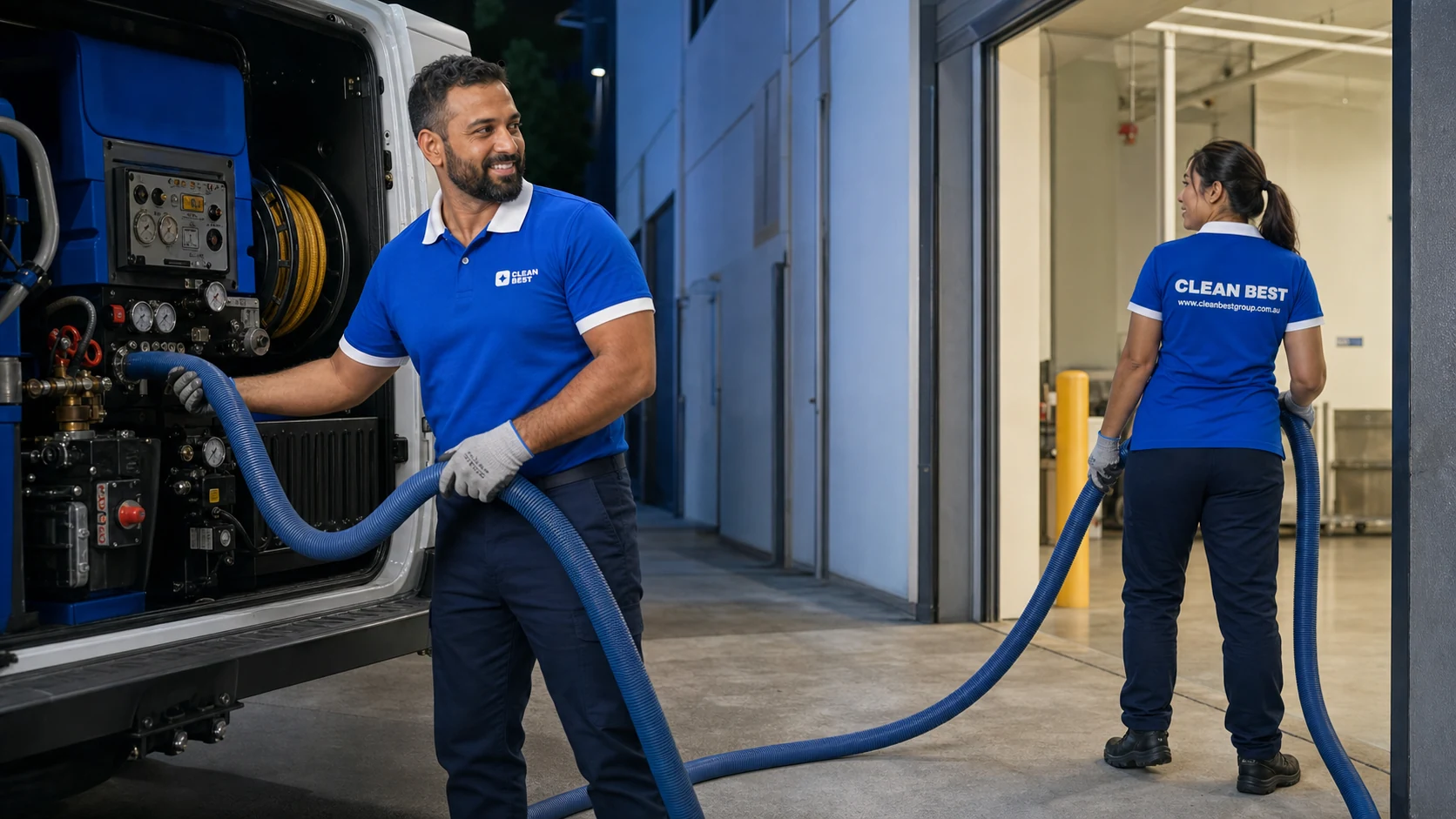
A commercial schedule is not a list, it is four lists running at four different speeds. The core round happens every visit and is the one people see. The weekly detail round is the one that keeps the premises looking cared for rather than merely serviced. The monthly rotation is the one nobody notices until it has been skipped for a year.
Periodic programs are the fourth, and they are the ones that decide what the building looks like in five years rather than five weeks. Every task in your scope carries a cycle from one of these four, which is what makes an audit possible: you cannot fail a schedule that never said when anything was due.
- Core round: waste, amenities, kitchens, touchpoints, floors
- Weekly detail: glazing, meeting rooms, the surfaces that mark
- Monthly rotation: vents, light fittings, partition tops, cable trays
- Periodic: carpet extraction, hard-floor treatment, external glass
The four layers
What runs on which cycle
The shape of a Sydney commercial schedule. Yours is written from your premises — this is the structure it will take.
| Layer | Cycle | What it contains |
|---|---|---|
| Core round | Every visit | Waste and recycling, washrooms, kitchens, touchpoints, all floors, entry glass, reception reset |
| Detail round | Weekly | Internal glazing and partitions, meeting rooms, breakout furniture, skirtings, the surfaces that mark |
| High and hidden | Monthly to quarterly rotation | Vents, light fittings, ceiling corners, partition tops, cable trays, behind and beneath fixed furniture |
| Periodic programs | Scheduled cycle, costed in the scope | Carpet hot-water extraction, hard-floor strip and seal or buff, external and high-reach glass |
What's included
A commercial scope, written the way it should be
Specific enough to fail. That is the test — a scope you cannot fail is a scope you cannot enforce.
- Waste and recycling emptied, liners replaced, waste taken to the building bin room or kerb
- Washroom pans, urinals, basins, tapware, mirrors and partitions sanitised with contact time observed
- Washroom paper, soap and hand towel restocked from stock supplied by the party named in the scope
- Floor drains and surrounding grout treated on a stated cycle, not left to chance
- Kitchen benchtops, sinks, tapware, splashbacks and cupboard fronts cleaned; microwave interiors and fridge exteriors wiped
- Full fridge clear-out on an agreed calendar date that staff have been told about
- Touchpoints disinfected — handles, switches, lift buttons, printer panels, EFTPOS terminals
- Carpet vacuumed under and behind furniture and along skirtings, not only down traffic lanes
- Hard floors cleaned with the correct chemistry for the surface, named in the scope where it matters
- Internal glazing, partition panels and mirrors spot-cleaned; entry glass detailed
- Meeting rooms reset — tables, chair bases, whiteboards, AV remotes, cabling
- High-level rotation of vents, light fittings, ceiling corners, partition tops and cable trays
- Periodic programs scheduled with a cycle and stated as inside or outside the price
- Premises secured on exit — lights, doors, alarm, entry and exit logged
Excluded and quoted separately: work above safe reach, biological spills, trade waste, licensed trade work, and anything involving personal belongings or paperwork on desks.
Pricing
Commercial cleaning services, priced from the hours the scope needs
We count the amenities, measure the traffic lanes, check what the floors are made of, and work out the hours. Then the figure is fixed in writing before the first visit. There is no published rate on this site because an honest one does not exist.
Single-tenancy premises
One occupier, one entry, amenities you control yourself — a suite, a shopfront, a studio, a standalone unit.
- One to three rostered visits a week, outside your trading hours
- Waste, amenities, kitchen, floors and entry glass every visit
- One cleaner who keeps the site, not a nightly stranger
- Consumables handed to us, or left with the supplier you already use
Fixed price, in writing, before the first visit.
Tenancy inside a managed building
A floor or part-floor where base building rules apply — dock bookings, after-hours lift access, a security patrol, a building manager.
- Access documented with building management before the first shift
- Rotating periodic work costed into the schedule, not bolted on later
- Named supervisor, monthly written audit against your scope
- Insurance certificates and inductions filed with the building, not just you
Fixed price, in writing, before the first visit.
Portfolio and multi-site
Several premises across Sydney under one budget holder — branches, clinics, centres, depots or a mixed property portfolio.
- One scope per site, one supervisor accountable for the lot
- A site register recording what was done, where, and when
- One consolidated monthly invoice instead of chasing separate contractors
- Periodic programs sequenced by site so nothing is missed in the rotation
Fixed price, in writing, before the first visit.
Free walkthrough, then a written scope and a fixed price within 24 hours.
How it works
How a commercial cleaning service starts
Four steps. Most Sydney premises are walked within 48 hours of the first call.
- 1
The site details
Call 02 5839 3012 with the premises type, the surfaces, the amenity count and the hours the building will let a cleaner in.
- 2
An after-hours walkthrough
We see the premises as our cleaner will: bins full, floors used, the building empty. That walk is what the scope is written from.
- 3
The scope, area by area
Tasks and frequencies written against every named area, with methods where they matter and exclusions stated plainly. Then the fixed price.
- 4
Roster, induct, start
Your cleaner is assigned, inducted on the access procedure, and starts on the agreed date. A supervisor audits monthly against the scope.
FAQ
Questions about commercial cleaning services in Sydney
Scope, frequency, hours, consumables, multi-site work and what happens when something is missed.
What do commercial cleaning services in Sydney normally include?
Clean Best builds a Sydney commercial schedule from four layers. Every visit: waste, amenities, kitchens, touchpoints and floors. Weekly: internal glazing, meeting rooms, detail work on the surfaces that mark. Monthly or quarterly: high-level dusting, vents, light fittings, the tops of partitions. Then periodic programs on their own cycle — carpet extraction, hard-floor treatment, external glass. If a task is not written into one of those four layers, it does not happen, and no amount of goodwill changes that.
How is the cleaning frequency decided?
Clean Best sets frequency from use, not floor area. Two premises of identical size can need completely different schedules: what drives the work is how many people pass through, how many amenities they share, what the floors are made of, and whether the site tracks dirt in from a dock, a car park or a street. We recommend a frequency at the walkthrough, we tell you plainly if you are considering fewer visits than the site can carry, and we revisit it after the first month if we got it wrong.
Do you clean during business hours or after them?
Clean Best runs most Sydney commercial work outside trading hours — evenings for offices and professional suites, before opening for retail and hospitality, overnight where the building allows it. Daytime work is a different method, not the same method in daylight: cordless equipment, no wet floors across walkways, no strong odours near occupied desks. If you want a day porter for amenities and reception with the full clean still running after hours, we scope it that way from the start.
Who supplies the consumables, and who tracks them?
Clean Best can supply and manage consumables, or leave them with the supplier you already use — but the scope has to say which, because this is the single most common gap we find in an existing contract. When we manage them we restock washrooms and kitchens each visit, watch the usage so you are not paying for stock sitting in a cupboard, and flag a shortfall before it becomes an empty dispenser at 4pm on a Friday rather than after.
Can one contractor cover several premises across Sydney?
Clean Best does exactly that, and it is a large share of the work. Multi-site clients get one written scope per premises, one named supervisor accountable across all of them, a single site register recording what was done and where, and one consolidated invoice. Each site keeps its own consistent cleaner, because a shared anonymous roster stretched across a city is precisely how multi-site cleaning falls apart in the second quarter.
What happens when something in the scope is missed?
Clean Best returns and puts it right at no cost, ahead of your next scheduled visit — you call the supervisor, not a ticket queue, and it is booked. A monthly audit against your written scope means we usually find the drift before you do. If the same item is missed twice we change the method, the schedule or the cleaner rather than sending the same apology a second time. If a remedy is not written into your agreement with any contractor, you do not have one.
Is periodic work included or charged separately?
Clean Best states it either way, in writing, but never leaves it unsaid. Carpet extraction, hard-floor stripping and sealing, high-level work and external glass are equipment-heavy and cannot sensibly hide inside a nightly rate. They are listed in your scope with a cycle against each, and marked as either inside the price or quoted separately. A contract that mentions periodic work only as 'available on request' is a contract in which it never happens.
Keep exploring
The same approach, applied to a specific premises
Each of these pages takes the scoping method above and applies it to what that building actually needs.
Get commercial cleaning services Sydney premises can be audited against
Free walkthrough after hours. Written scope first, fixed price second, no lock-in term. Call 02 5839 3012 / 0485 000 860.